Context · The XV Olympiad
The 1952 Olympics
The Games that brought the Soviet Union in from the cold, admitted a new Israel, and gave a five-year-old independent India its first individual medallist.
Khashaba Jadhav's medal did not happen in a vacuum. The 1952 Helsinki Olympics were one of the most politically loaded Games of the twentieth century — the first at which the Cold War's two blocs met in open competition, and the first at which several nations created by the upheavals of the 1940s appeared at all.
The Soviet Union returns
Helsinki 1952 was the Soviet Union's first Olympic Games. A Russian team had last competed in 1912, under the Tsar. The USSR had stayed outside the Olympic movement for four decades, and its entry was the sporting event of the era. It finished second in the overall standings at its first attempt.
Anxiety about Cold War confrontation ran high enough that the Soviet team and the Eastern Bloc nations — Hungary, Poland, Bulgaria, Romania, Czechoslovakia — were housed in a separate Olympic Village from the Western competitors. The feared clashes did not materialise.
For Khashaba this was not an abstraction. The man who beat him in Round 5, Rashid Mammadbeyov, was part of that first Soviet delegation.
New nations, and returning ones
- Israel made its Olympic debut, having been unable to compete in 1948 during its war of independence.
- Japan and Germany returned after being excluded from the 1948 Games as the defeated powers of the Second World War. Germany was represented entirely by West German athletes, the East having declined to compete on a joint team.
Both facts touch Khashaba's story directly: his gold-medal opponent, Shohachi Ishii, became the first Japanese Olympic champion of the post-war era, and his Round 3 opponent, Ferdinand Schmitz, wrestled for a Germany competing for the first time in sixteen years.
India at Helsinki
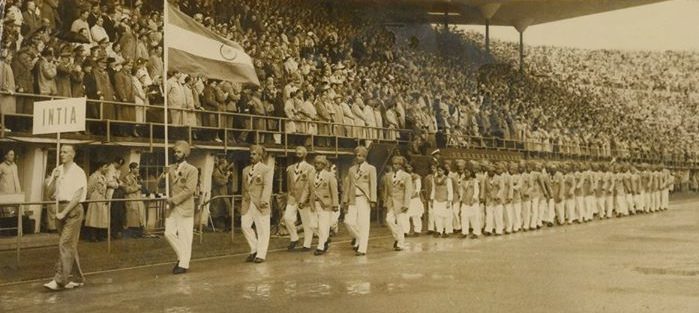
India arrived in Finland as a nation not yet five years independent, and still living with the consequences of Partition. Its Olympic reputation rested almost entirely on the field hockey team, which duly won gold again in 1952 — a magnificent achievement, and a collective one.
What India had never had was an individual Olympic medallist under its own flag. Norman Pritchard had won two silvers at Paris in 1900, but in the era of the British Raj and under circumstances still debated by historians. Khashaba Jadhav's bronze was something categorically new: an Indian competing alone, for a free India, finishing third in the world.
The wrestling
Wrestling at these Games was contested at Messuhalli under the “bad points” elimination system described on the Helsinki bouts page. Twenty nations entered the bantamweight freestyle division alone — a measure of how genuinely global, and genuinely competitive, the event was.
In that field, an athlete who had learned his craft on village earth, funded by neighbours, with no team officials present to represent him, finished third.