Chapter Two · 1948
London 1948
A Maharaja's patronage, an English coach, and an Indian wrestler's first encounter with a wrestling mat.
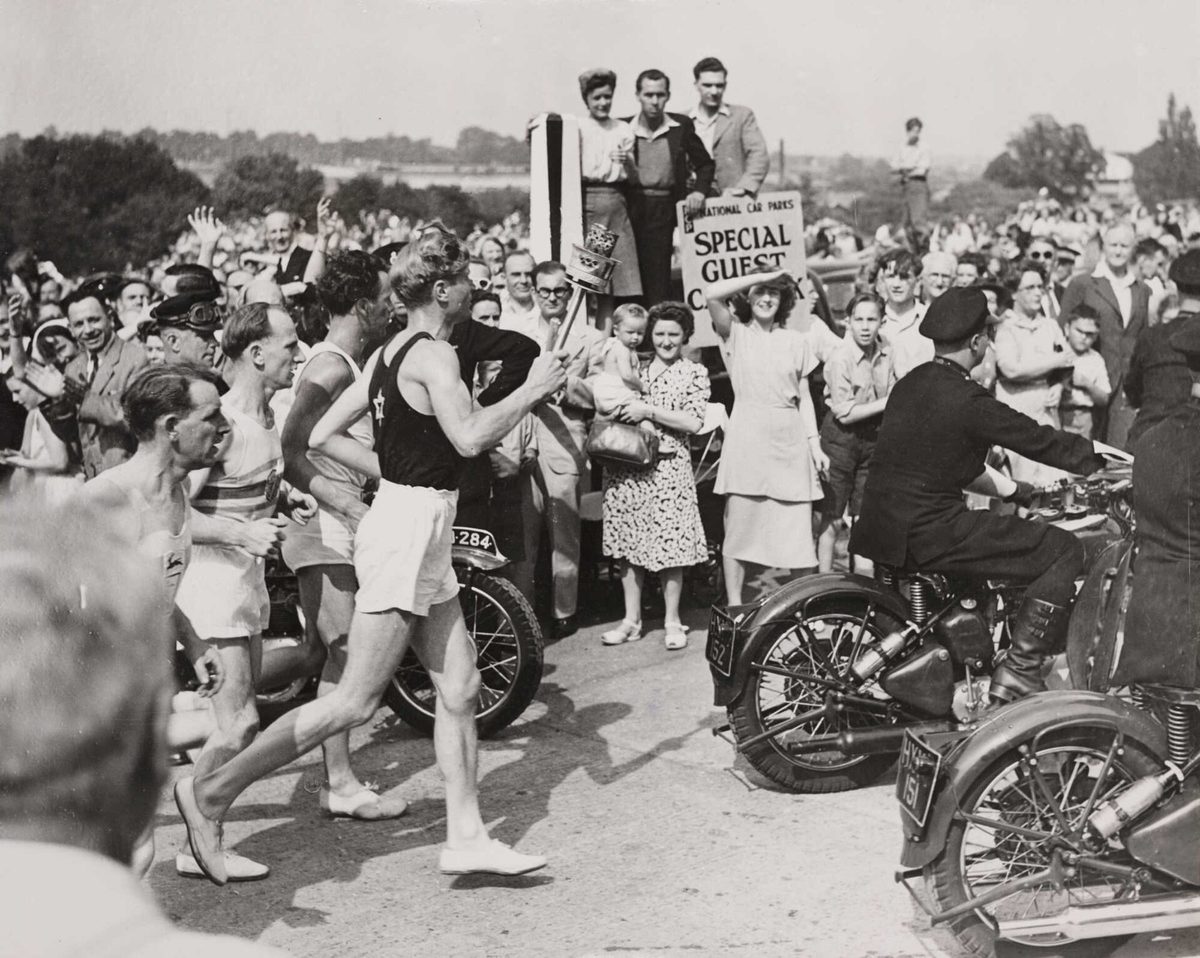
The 1948 London Olympics were the first Games held after the Second World War — a twelve-year gap, and an event so straitened that competitors were asked to bring their own towels and food rations. They are remembered as the “Austerity Olympics.” They were also the first Games at which India competed as an independent nation, less than a year after the transfer of power.
Getting there
Khashaba's selection had been earned in the pit at Lucknow, but selection did not come with money. His passage was financed by Shahaji II, the Maharaja of Kolhapur — the last working expression of the princely patronage system that had built wrestling in the region. In London, Khashaba trained under the English coach Rees Gardner.
Earth versus mat
The single most important fact about Khashaba's 1948 campaign is technical. Indian kusti is contested on soft earth; Olympic freestyle wrestling is contested on a mat. The surfaces reward different footwork, different balance, and completely different approaches to going to ground. Khashaba had spent roughly fifteen years perfecting his craft on one surface, and was now asked to perform on the other, in international competition, with a few weeks' acclimatisation.
The bouts
Competing in the flyweight freestyle division, Khashaba won his opening two bouts and lost his third.
v. Bert Harris (Australia)
WinWon 3–0.
v. Billy Jernigan (United States)
WinWon 3–0.
v. Mansour Raeisi (Iran)
LossLost by technical fall at 5:31, against one of the strongest wrestling nations on earth.
He finished sixth in the world.
What he took home
Sixth place at an Olympic Games would be a career for many athletes. For Khashaba it was a measurement. He had discovered exactly how wide the gap was between himself and the podium, and concluded — correctly — that it was closeable. He spent the next four years closing it, adapting his earth-trained technique to the mat.
What he could not have anticipated was that the political ground beneath him was about to shift. The princely states were being integrated into the Indian Union; Kolhapur's patronage of wrestling, and the Maharaja's purse that had put him on a plane to London, would not be there in 1952.